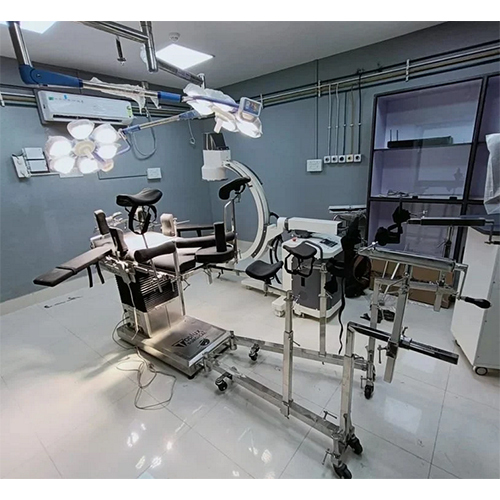
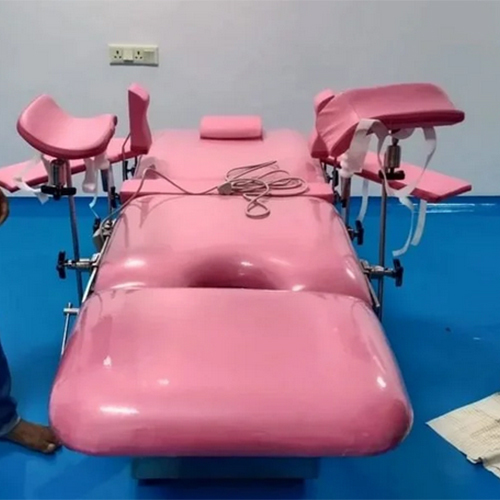
About Orthopaedic OT Table
| Parameter |
Details |
| Dimensions |
2000 mm x 500 mm |
| Drawing Range |
200 mm |
| Device Length |
1100 mm |
| Leg Support Height |
650 -850 mm |
| Under Frame Angle |
0 - 180 deg |
| Traction Shoes |
1 Pair |
| Long Leg Support |
1 Pc |
| Short Leg Support |
1 Pc |
| Pelvis Support |
1 Pc |
| Perineum Column |
1 Pc |
| Leg Straps |
1 Pc |
| Leg Support Roller |
1 Pc |
| Separating Leg Support |
1 Pc |
| Supporting Trolley |
1 Pc |
| Shoulder Support |
2 Nos. |
| Arm Rest |
2 Nos. |
| Anaesthetic Screen Frame |
1 No |
| External Power Supply Cable |
1 No |
| Thigh Rest |
2 Nos. |
| Buttock Side Support |
2 Nos. |
| Molded Mattress |
1 No |
| Foot Support |
2 Nos. |
Surgical Precision with Flexible DesignThis orthopaedic OT table offers superior flexibility with its four-section top and detachable leg segment. The manual crank mechanisms and side lever facilitate smooth position control, ensuring precision during orthopaedic surgeries. Designed for ease of use and robust performance, it can accommodate a broad spectrum of requirements in hospitals and clinics.
Durable Construction for Clinical ReliabilityManufactured from 304 grade stainless steel, this table is built to withstand frequent use in demanding environments. The radiolucent tabletop allows for clear imaging without repositioning the patient, and the removable mattress ensures consistent hygiene practices.
Suitable for Diverse Orthopaedic ProceduresWith accessory-mountable side rails and an adjustable height mechanism, this table can be tailored to suit various orthopaedic surgical interventions. Its detachable leg section and ergonomic design promote optimal accessibility, making the surgical process more efficient for healthcare professionals.
FAQ's of Orthopaedic OT Table:
Q: How is patient positioning achieved on this orthopaedic OT table?
A: Patient positioning is adjusted manually using the side lever and the manual crank system, which allow for controlled serial movements. The four-section design and back rest lifting angle (0-80) provide a wide range of positions suitable for orthopaedic surgeries.
Q: What distinguishes the table's top section for orthopaedic procedures?
A: The top section is radiolucent, enabling seamless imaging during procedures without the need to reposition the patient. Its four-section design and detachable leg segment further enhance accessibility and flexibility during complex surgical interventions.
Q: When should the detachable leg section be used?
A: The detachable leg section should be utilized when enhanced access to the lower extremities or a specific orthopaedic positioning is required. This function is particularly beneficial during surgeries involving the legs, hips, or pelvis.
Q: Where can this OT table be used effectively?
A: The table is ideal for use in hospital operating theatres and clinical environments focused on orthopaedic surgical procedures. Its robust build and functional features make it well suited to high-demand clinical settings across India and internationally.
Q: What is the process for adjusting table height and position during an operation?
A: Height adjustment is performed manually with a crank, allowing the table's elevation from 750 to 950 mm. Positioning the patient is managed using the side lever and manual cranks for section movement, ensuring seamless adaptation to surgical needs.
Q: What are the benefits of the radiolucent tabletop in surgery?
A: The radiolucent tabletop allows X-rays and imaging equipment to obtain clear, unobstructed views of the patient, thereby improving intraoperative diagnosis and reducing the need for patient repositioning. This leads to increased procedural accuracy and efficiency.
Q: Which accessories can be mounted onto the side rails?
A: The accessory-mountable side rails can accommodate various orthopaedic supports, clamps, and positioning devices to tailor the table setup for specific surgical requirements, enhancing the versatility of the operation table.

 Send Inquiry



 Send Inquiry

 Send Inquiry


 English
 Spanish
 French
 German
 Italian
 Chinese (Simplified)
 Japanese
 Korean
 Arabic
 Portuguese